Creating a new script for modern Arabic
Arabizi, or Arabic chat alphabet, is great—but we should strive for better.
Last updated on 9 April 2026 at 5:10 AM UTC+0
 Parents in Arabic-speaking countries are less likely to read to their children than parents in other countries (World Bank).
KATRIN BOLOVTSOVA/Pexels.
Arabizi is a script for writing Arabic that evolved out of necessity, using numbers and English letters to write Arabic when the Arabic script was not digitally supported. The most commonly used numbers are 3 to denote a (ع), 2 to denote a (ء), and 7 to denote a (ح). The numbers 5 and 8 are used to denote (خ) and (غ), respectively, but these are now more commonly written as ‘kh’ and ‘gh’.
Eventually, digital support for the Arabic script improved. But in Lebanon, Arabizi is still the most commonly used script for texting. Texting in the Arabic script, although now possible, is frowned upon, especially among younger Lebanese, who prefer reading, typing, and even handwriting Levantine Arabic in Arabizi.
The Arabic script is worse than Arabizi in many ways. For example:
- the Arabic script requires learning a different keyboard layout.
- the Arabic script’s abjad nature makes it harder to read.
- writing English and French loanwords in the Arabic script is awkward.
- writing English and French loanwords in the Latin script would lead to bidirectional text layout problems, especially at the beginning of a line.
PALON
As the usage of Arabizi evolved, people’s tendency to prefer ambiguous letters over numbers (which I’ll call PALON) is making the script harder to read. I find the PALON tendency comparable to the tendency to unhyphenate English words after their usage becomes common (ex: e-mail → email). As such, it is possible to write entire sentences in Arabizi using fewer than two numbers.
The first article of the UDHR in Levantine using PALON (two numbers; both 3):
Btekhlae kil l nes ahrar w mitsewyin bil karameh wel heoue. W nwahabo 3ael w damir w lezim y3emlo baad b rouh l oukhouwweh
The first article of the UDHR in Levantine using numbers more often (ten numbers; four 2s, three 3s, and three 7s):
Btekhla2 kil l nes a7rar w mitsewyin bil karameh wel 72ou2. W nwahabo 3a2l w damir w lezim y3emlo ba3d b rou7 l oukhouwweh
Additionally, the presence of numbers in words will never be seen as formal, numbers cannot be capitalized, and PALON introduces multiple ways of writing the same word (for example la2 and lae).
Shamizi
The Shamizi script, a portmanteau of Shami (Levantine Arabic) and Arabizi, fixes the ambiguity of PALON without using numbers.
The script will use ẻ instead of e and ħ instead of h to denote (ء) and (ح) respectively. Additionally, ȝ will be used instead of 3 to denote ع.
I chose the Ẻ because:
I chose the Ħ because:
- h is used to denote a ح in PALON.
- in the International Phonetic Alphabet, the ح is denoted by ħ.
- in Maltese, the only Arabic language with a standardized Latin script, ħ is used for the ح sound.
I chose the Ȝ because:
- it looks like its equivalent Arabic script letter ع.
- it looks like its equivalent Arabizi number 3.
- it has lowercase and uppercase variants, unlike the number 3.
Shamizi sample text
Sample text isn’t available under a Creative Commons license.
Article 1 of the Universal Declaration of Human Rights
Btekhlaẻ kil l nes aħrar w mitsewyin bil karameh wel ħẻouẻ. W nwahabo ȝaẻl w damir w lezim yȝemlo baȝd b rouħ l oukhouwweh.
“Asħabi” by Mashrouȝ Leila
♪ Killoun ȝam yorẻso foẻ l ẻzez ȝal ẻard ♪
♪ Killoun ȝam yodħako bil aswad wel abyad ♪
♪ Bit shaẻshiẻ basimte aswad w abyad ♪
♪ Naħna baȝdna shi mitȝarfin ȝa baȝd ♪
“Wazaffak?”, theme song of Mafi Metlo
-♪ Wazafak? ♪
-♪ Ma wazafne ♪
♪ Maȝ eno reħeh bakir w ȝlẻt b ȝajẻit seir ♪
♪ Fi mawȝad maȝ l moudir w menno mitfẻal bil kheir ♪
♪ Bas shefetne l secrétaire, ẻjt l ȝando alitlo, “Hal shab ktir mrattab. B jannin. Mafi metlo.” ♪
-♪ Wazafak? ♪
-♪ La ma wazafne. ♪
♪ Ẻal l ħale saȝbe ktir. W mafi ȝanna wazayif. Law wassa fik l wazir, l balad mitelma sheyif. ♪
♪ Saħibto twassit fiyye, ẻaȝdit ħaddo w sharħitlo, “Badl l shhede fi miyye. Mitȝallim. Mafi metlo.” ♪
-♪ Tayyib wazafak? ♪
-♪ Ensa. Ma wazfne. ♪
♪ Ȝa bayte badde ẻrjaȝ, w erkhiha b hal salon. Jare la ȝande yotlaȝ, w ndawwir l télévision. ♪
♪ Khayye laptoppo manzouȝ, w manne fadye farmitlo. ♪
♪ W law badde mout mnil jouȝ, raħ oħdar Mafi Metlo. ♪
-♪ Wazzafak? ♪
-♪ Wallah yaret, he-he, ma wazafne. ♪
The “Bit emin b Allah?” scene from LBCi’s Marħaba Dawle with Shamizi subtitles
Adding the Shamizi keyboard layout
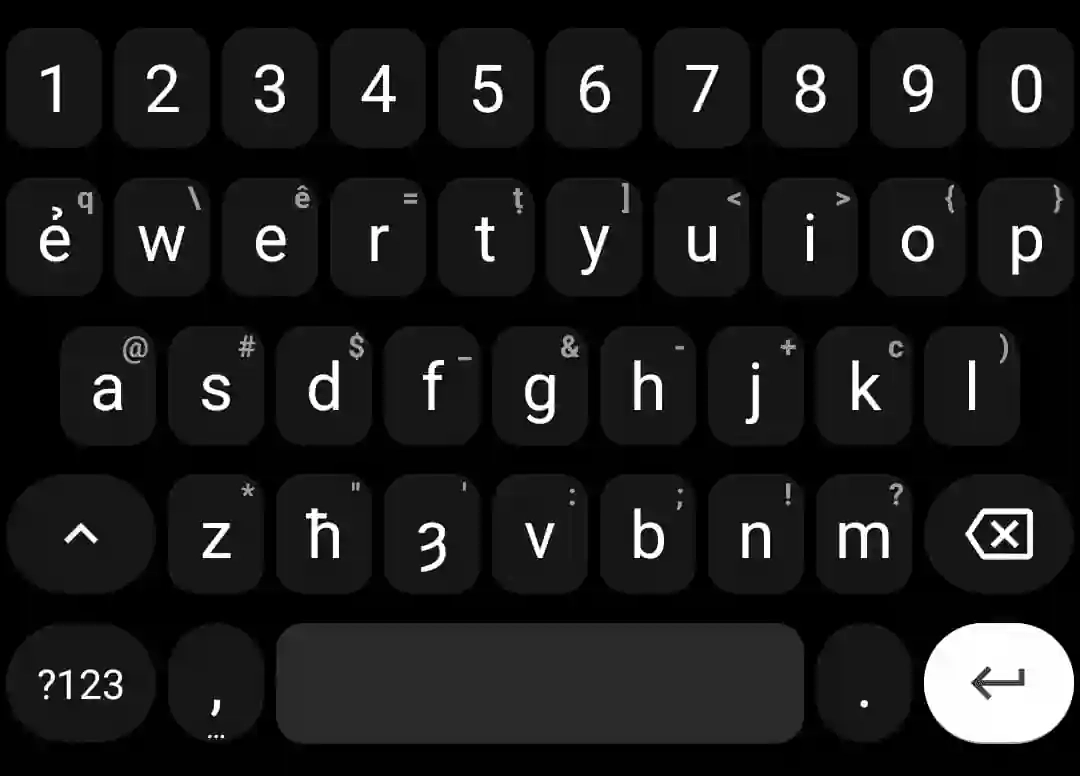 Shamizi layout on HeliBoard.
On Android
- Install the HeliBoard keyboard app.
- In “Languages & Layouts”, select “No language”, and press the “+” symbol next to “Layout”.
- Optionally name the layout Shamizi and add the following simple layout:
ẻ q ɂ
w
e ê è é
r
t ṭ
y
u
i
o
p

a
s # ṣ c ç
d $ ḍ
f
g
h
j
k c x q
l

z * ż
ħ " » « x ƹ
ȝ ' c ç
v
b
n
m
Other devices
If you’ve added Shamizi to your device, contact me and I’ll update this blog to add your layout.
Source
- World Bank